I've finally begun building the boat I've wanted to build for years, and the final decision was based on how well Element sails and my enjoyment of the restoration process. I love the elegant simplicity of these Wharram Tiki designs, enough to commit myself to building a Tiki 26 over the course of the next year or two in my spare time. For my needs, the Tiki 26 is the ideal size, still small enough to easily manage for maintenance and moving to different locations on a trailer, yet big enough to have good sitting headroom in the cabins, enough load capacity for long voyages, and the same shallow draft and light weight advantages of the Tiki 21. I still intend to sail Element at every opportunity, and I'm planning some multiday cruises on her a little later this year, but as time permits I will be steadily working away at building Element II. I'll be documenting the process here on a new blog:
http://tiki26element2.blogspot.com
Hope to see you there....
Wednesday, January 31, 2007

Sunday, January 28, 2007
Sunny Winter Day


I went sailing Friday. This was the first time I've sailed the boat in sunny weather since the launching. Friday's forecast was for stronger wind when I was planning the trip, but as it turned out the cold front that had kept the north winds at 15-20 knots the two previous days had started to blow itself out, and by the time I got to the coast, the wind was east-southeast at maybe 10 knots. The sailing was nice, and Element handled well in the diminishing chop out in the sound, but I still couldn't get more than about 6 knots out of her in those conditions. We'll see when I finally manage to get out on a windy day. I had a fine close reach back into the harbor at Biloxi, and was able to point higher than I ever imagined possible in the combination of light winds and smooth waters.
Saturday, January 20, 2007
Nice Daysail

Although the wind was really light, maybe 5-7 knots and even less at times, I enjoyed some fine sailing on my most recent day aboard Element. It's amazing how well these boats sail in light air. This is because of the light weight and the slim, easily driven hull forms. In these conditions the Tiki 21 cruises effortlessly along at 5-6 knots, making very little fuss and hardly rippling the water in her wake.
Friday, December 15, 2006
Foggy, Windless Day on the Gulf

Deer Island barely visible in the fog

Out in the sound near West Ship Island
Yesterday was not a good day for sailing, but I couldn't stand it any longer and had to get out on Element after being sick for nearly a week with cold and flu-like symptoms. The forecast was for a light north wind, up to 10 knots, but the wind wasn't there, and instead when I got to the marina what I found was dead calm.
Well, the new outboard needed breaking in anyway, so I took this as an opportunity to do so and to check fuel consumption and cruising speed under power. I kept it at half throttle or slightly under half while heading out the West Biloxi Channel into the sound, averaging 5-5.5 knots. There was some fog and haziness in the air, but with the sun trying to burn through, I thought it would all be gone by late morning. As it turned out, when I got out to the ICW crossing in the sound, almost to West Ship Island, the fog was still hanging around. Well clear of the channel, I shut down the engine and drifted while I ate lunch and made coffee. With the fog starting to increase, I decided not to go on to the barrier islands, as I had not planned on staying overnight on this trip and didn't want to get socked in until sometime the next day.
The engine ran perfectly, and on the way back in I ran it part of the time at more than half throttle, and tried it wide open. 6 knots was easy to maintain, and 7 was attained at full throttle. Even though a 4hp, 4-stroke is more than enough power for a Tiki 21, it's hard to get much more speed under power, as a lot of the extra thrust is wasted. Running at half throttle or less though is incredibly efficient, with more than enough reserve for headwinds and strong currents. The total distance motored was 20.7 nautical miles, averaging 5.5 knots, and burning a whole gallon of gas from my 3-gallon tank! I can't complain about that. I am looking forward to some decent wind, however, as I know this boat will be much faster under sail than under power, just like my Hitia 17 was.
On the way back in I was approached by a U.S. Coast Guard patrol in a stealthy, small boat that was right up on me before I realized it. They were nice though, just commenting on the danger of the fog as they came alongside, and looking at my unusual craft.
I stopped on Deer Island, running the bows up to the beach so I could try to sort out the main halyard problem that made raising the mainsail difficult the day we launched the boat and first sailed. It seemed to be the throat halyard that was the problem, and thinking it was somehow twisted or jammed. I decided to drop the mast to check it, even though I was alone. I had done this many times when the boat was in the yard, so I was confident I could get it back up without help. Other than the fact that the deck was wet and slippery, it proved to be no problem. I couldn't find a reason for the jamming, but after re-stepping the mast and finding the gaff would still not go up very well, I decided to pull the halyards outside of the sail sleeve pocket. This did the trick, and the sail is now easy to raise. Although the halyards are supposed to be inside the pocket to clean up the airflow around the sail, I think this is hardly beneficial enough to be worth the hassel of a sail that's hard to raise.
By the time all this was done, the fog had gotten worse to the point of being dangerous. I could no longer see the Biloxi channel and could barely see 100 yards from Deer Island. With many large commercial fishing vessels going to and fro in this channel, getting back to Point Cadet could be dangerous. But the shallow draft advantage of a catamaran decreased this somewhat, allowing me to closely follow the shore of Deer Island to the east through an area of 2-3 depths until I was adjacent to the marina. This way I only had to cross the channel briefly at a 90 degree angle, minimizing the time in water deep enough for large vessels.
Thursday, December 07, 2006
Years of Fascination with Wharram Catamarans
 Segundo Vez: Hitia 17
As I've noted here before, Element is not the first Wharram catamaran I've owned, nor will it be the last. I've been fascinated with these designs since I first came across them back in 1997.
Just last week, I sold the first Wharram cat that I built and owned, the Hitia 17, Segundo Vez.
On my other blog, Island Time Online, I've posted a brief summary of how I came to build my first Wharram, why I got into monohull sailing for awhile, the purchasing and rebuilding of this Tiki 21 that has been rechristened, Element, and my future plans for building my next Wharram. Read it more here: http://islandtimeonline.blogspot.com/2006/12/time-to-move-on.html
Wednesday, December 06, 2006
Ready at the Dock
 Element's new home on the Gulf Coast
I haven't sailed Element since the launching last week. When we docked on Thursday morning in the new slip the tide was up, so I drove back down on Saturday morning to make sure there was enough slack in the lines at low tide, which was at 6:25 am. One can never be too carefull tying a 12-foot wide boat up in a slip that is just barely over 13-feet wide, especially when the docks are concrete.
It was barely above freezing when I was there Saturday morning, with a north wind over 20 knots, so I decided to hold off on sailing until I could get better conditions for a good shake-down cruise. There are some minor details with the running rigging to work out, such as getting the main halyards to run free. I also need a better system for cleating the mainsheet and I need to replace the horn cleat I used on the front of the mast to hold down the tack of the main with a smooth fairlead that can't snag the jib sheets when coming about. I've also got to make stronger cockpit seats for to fit over the hatch coamings, as the originals were too lightly built. These are all simple details that can probably be worked out in short order.
The forecast is looking good for the upcoming weekend, with the northerly winds shifting back to east on Saturday and then southeast on Sunday, with warmer daytime temps. I plan to take an overnight cruise out to the barrier islands, which one doesn't matter, I'll just head for the one that is on the most favorable beam reach.
Saturday, December 02, 2006
More Launching Photos
 Loading all the parts on the trailer
 Ready for the road
On the beach at Biloxi

Afloat at last, Bill and Houston Barker in the
background (photo by Artie Vaughn)

At anchor off Deer Island the next morning

At anchor off Deer Island the next morning
Friday, December 01, 2006
Element is Afloat!
 Element at anchor off Deer Island, Biloxi, Mississippi
The launching of Element finally happened Wednesday, after a much longer than anticipated refit. The whole thing, from trailering to the Gulf coast to offloading the hulls, assembly, rigging and sea trials went smoother than I ever expected. To this I owe thanks to all the great help I had from my good friend Artie Vaughn, of the sailing vessel Halcyon, and to Bill Barker and his son Houston, who traveled all the way from Colorado to participate in this launching and to buy my Hitia 17, Segundo Vez.
We arrived at the beach in Biloxi shortly before 9:00am and took our time to carefully move the hulls to the water's edge and assemble the boat and stow all the gear. Since I don't intend trailering this Tiki 21 except to bring it home for maintenance, I was more concerned with taking great care to get everything right than to try and see how fast I could get the boat from the trailer to sailing. We enjoyed conversation as we worked and took a break for lunch, but by 2:58pm, all gear was on board for an overnight excursion and vehicles and trailer were shuttled to the parking lot of the marina where the boat will be docked. We then shoved off and motored upwind to get away from the broken pilings of the many hurricane damaged piers along the beach before raising the main and jib and bearing away on a beam reach. Other than some issues with the main and jib halyards not working smoothly inside the mainsail sleeve, the boat performed as expected and felt much like sailing the smaller Segundo Vez.
Tuesday, November 28, 2006
Tomorrow is Launching Day!
Element will finally be afloat again sometime tomorrow. I completed the disassembly and washed the hulls and all parts yesterday, and today will load everything on the trailer for the trip to the beach in Biloxi. I will have help with this from a new Wharram enthusiast who has driven here to Mississippi from Colorado with his son to purchase my other Wharram catamaran, the Hitia 17, Segundo Vez.
Today we will prepare Segundo Vez for the trip to her new home in the Rocky Mountains and finish organizing all the gear needed to sail Element. After launching tomorrow, we will day sail around Biloxi and hopefully sail overnight to the barrier islands that lie approximately 10 miles to the south across the Mississippi Sound.
Today we will prepare Segundo Vez for the trip to her new home in the Rocky Mountains and finish organizing all the gear needed to sail Element. After launching tomorrow, we will day sail around Biloxi and hopefully sail overnight to the barrier islands that lie approximately 10 miles to the south across the Mississippi Sound.
Thursday, November 16, 2006
Hitia 17 and Tiki 21
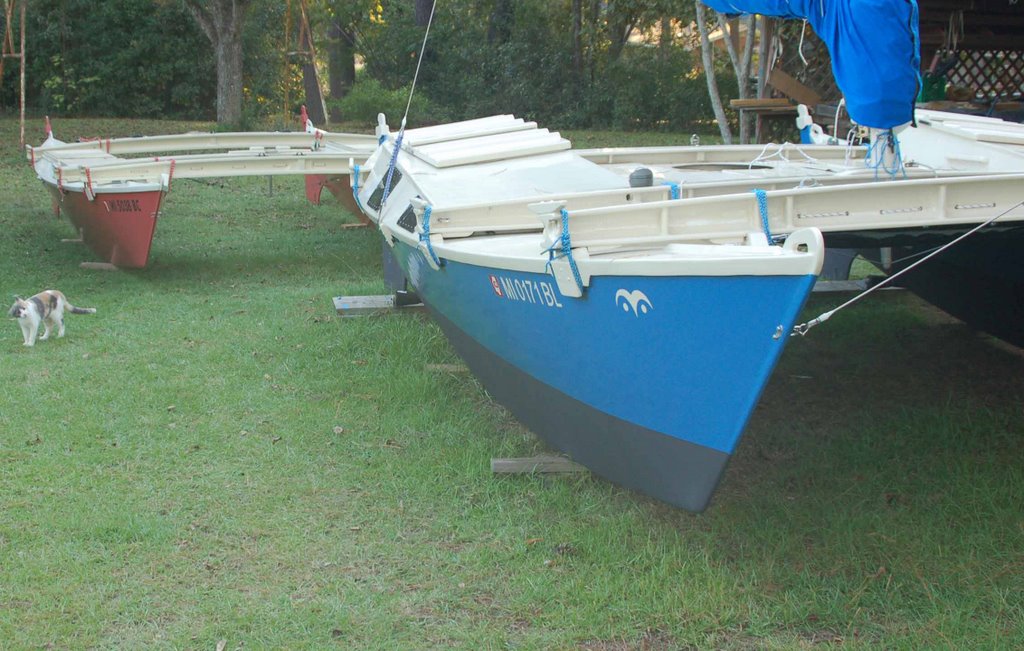
This photo shows the size difference between my Tiki 21 Element, and my Hitia 17 Segundo Vez. The perspective with Segundo Vez farther away makes it look even smaller, but there is a significant difference in four feet of length. The Tiki range from the Hitia 17 to the Tiki 30 increases in four-foot increments. Each size, however, is almost twice the volume of the next size smaller, hence a Tiki 21 cost about twice as much and requires about twice the time to build as the Hitia 17. This ratio is roughly the same going from a Tiki 21 to a Tiki 26, and from a Tiki 26 to a Tiki 30. In boats volume definately increases at a ratio exponential to overall length.
Each of these four sizes of the Tiki range has its own advantages and disadvantages, making each more suitable for some purposes than others. The Hitia 17 is for sure easier to deal with, with each hull weighing in at only about 90lbs. It can be easily trailered and set up quickly for sailing. What it lacks is any accomodation in the hulls when the weather turns nasty. The Tiki 21 is barely better, but does at least offer much more storage and a dry bunk in each hull, if not room to actually sit up inside with the hatches closed. The Tiki 21 is sort of an in-between size in my view, a little too big and difficult to set-up for easy trailering, at least the kind of trailering where you keep the boat at home and drive to the ramp for a few hours of day sailing. I'll be keeping mine in the water, which means paying for a dock space, which will make sailing much more convenient, but the boat is still too small for living aboard or comfortably hanging around on in a marina setting. It is a boat that will truly be in it's element out there sailing, and should be great for camp cruising and gunkholing around barrier islands and estuaries, while offering the ability to go offshore safely.
Moving up to the Tiki 26 and Tiki 30, one gets into a class of catamarans that are easily capable of long distance bluewater sailing, and both have been well-proven in this regard. The Tiki 26 offers sitting headroom in each hull, as well as two bunks in each and room for a basic galley, a portable toilet and storage for everything needed for one or two people to make an ocean crossing. At just 1500 pounds of boat weight, it still can be trailered, but will be more of a job than the Tiki 21 to assemble/disassemble. The Tiki 30, with it's deeper hulls and more volume inside offers room for a double bunk in each hull, more of a dedicated galley, toilet area, and even more storage. It's a lot more to build in many ways than the Tiki 26, based on my careful study of the plans for each, simply because of the increased size of the scantlings for stringers and other solid parts, the addition of mini-keels in the V-hulls and the complexity of the cockpit, mast, and other details. But it undoubtedly offers more comfort than any of the other small Tikis and the longer waterline length would make for more comfort and speed offshore in rough conditions.
The bottom line is that all boats are compromises, and you must give up one quality to gain another. Having built and sailed the Hitia 17, I'm looking forward to experiencing the capabilities of the Tiki 21. I'll also have one each of the Tiki 26 and Tiki 30, in a perfect world. But seriously, I am going to build another, not only in a quest to get the boat most appropriately sized for my needs, but to control the process from beginning to end so that every part of the boat will be of the best materials and best workmanship I can put into it. More will follow on this, but first there will be more details about the refit of Element, and soon, the sailing and cruising that will follow her launching.
Subscribe to:
Posts (Atom)

