Element will finally be afloat again sometime tomorrow. I completed the disassembly and washed the hulls and all parts yesterday, and today will load everything on the trailer for the trip to the beach in Biloxi. I will have help with this from a new Wharram enthusiast who has driven here to Mississippi from Colorado with his son to purchase my other Wharram catamaran, the Hitia 17, Segundo Vez.
Today we will prepare Segundo Vez for the trip to her new home in the Rocky Mountains and finish organizing all the gear needed to sail Element. After launching tomorrow, we will day sail around Biloxi and hopefully sail overnight to the barrier islands that lie approximately 10 miles to the south across the Mississippi Sound.
Tuesday, November 28, 2006

Thursday, November 16, 2006
Hitia 17 and Tiki 21
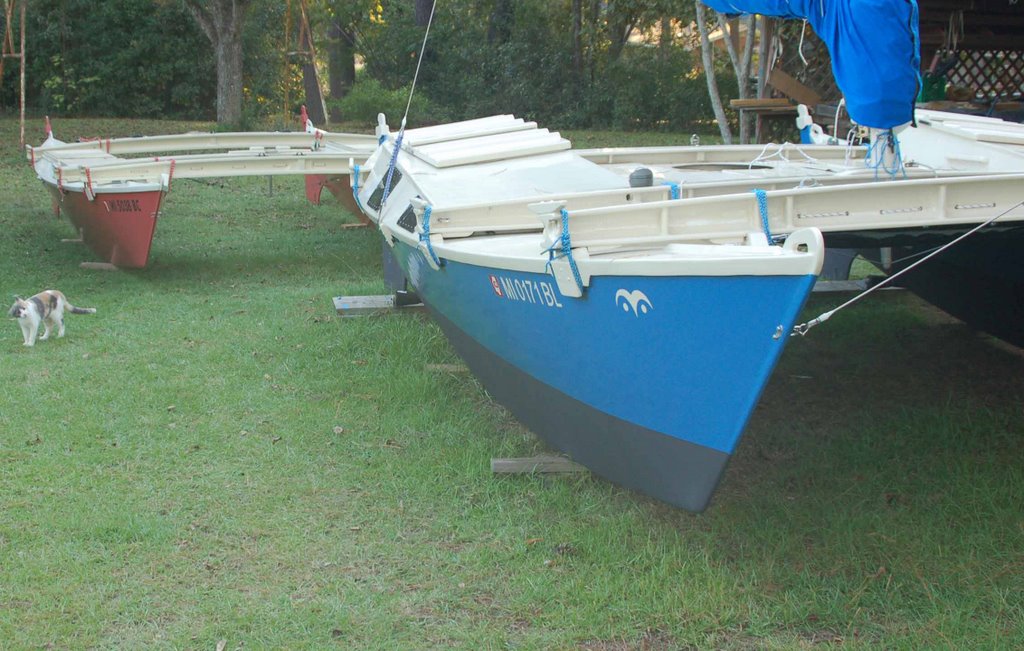
This photo shows the size difference between my Tiki 21 Element, and my Hitia 17 Segundo Vez. The perspective with Segundo Vez farther away makes it look even smaller, but there is a significant difference in four feet of length. The Tiki range from the Hitia 17 to the Tiki 30 increases in four-foot increments. Each size, however, is almost twice the volume of the next size smaller, hence a Tiki 21 cost about twice as much and requires about twice the time to build as the Hitia 17. This ratio is roughly the same going from a Tiki 21 to a Tiki 26, and from a Tiki 26 to a Tiki 30. In boats volume definately increases at a ratio exponential to overall length.
Each of these four sizes of the Tiki range has its own advantages and disadvantages, making each more suitable for some purposes than others. The Hitia 17 is for sure easier to deal with, with each hull weighing in at only about 90lbs. It can be easily trailered and set up quickly for sailing. What it lacks is any accomodation in the hulls when the weather turns nasty. The Tiki 21 is barely better, but does at least offer much more storage and a dry bunk in each hull, if not room to actually sit up inside with the hatches closed. The Tiki 21 is sort of an in-between size in my view, a little too big and difficult to set-up for easy trailering, at least the kind of trailering where you keep the boat at home and drive to the ramp for a few hours of day sailing. I'll be keeping mine in the water, which means paying for a dock space, which will make sailing much more convenient, but the boat is still too small for living aboard or comfortably hanging around on in a marina setting. It is a boat that will truly be in it's element out there sailing, and should be great for camp cruising and gunkholing around barrier islands and estuaries, while offering the ability to go offshore safely.
Moving up to the Tiki 26 and Tiki 30, one gets into a class of catamarans that are easily capable of long distance bluewater sailing, and both have been well-proven in this regard. The Tiki 26 offers sitting headroom in each hull, as well as two bunks in each and room for a basic galley, a portable toilet and storage for everything needed for one or two people to make an ocean crossing. At just 1500 pounds of boat weight, it still can be trailered, but will be more of a job than the Tiki 21 to assemble/disassemble. The Tiki 30, with it's deeper hulls and more volume inside offers room for a double bunk in each hull, more of a dedicated galley, toilet area, and even more storage. It's a lot more to build in many ways than the Tiki 26, based on my careful study of the plans for each, simply because of the increased size of the scantlings for stringers and other solid parts, the addition of mini-keels in the V-hulls and the complexity of the cockpit, mast, and other details. But it undoubtedly offers more comfort than any of the other small Tikis and the longer waterline length would make for more comfort and speed offshore in rough conditions.
The bottom line is that all boats are compromises, and you must give up one quality to gain another. Having built and sailed the Hitia 17, I'm looking forward to experiencing the capabilities of the Tiki 21. I'll also have one each of the Tiki 26 and Tiki 30, in a perfect world. But seriously, I am going to build another, not only in a quest to get the boat most appropriately sized for my needs, but to control the process from beginning to end so that every part of the boat will be of the best materials and best workmanship I can put into it. More will follow on this, but first there will be more details about the refit of Element, and soon, the sailing and cruising that will follow her launching.
Wednesday, November 15, 2006
Nissan 5HP 4-Stroke Auxillary

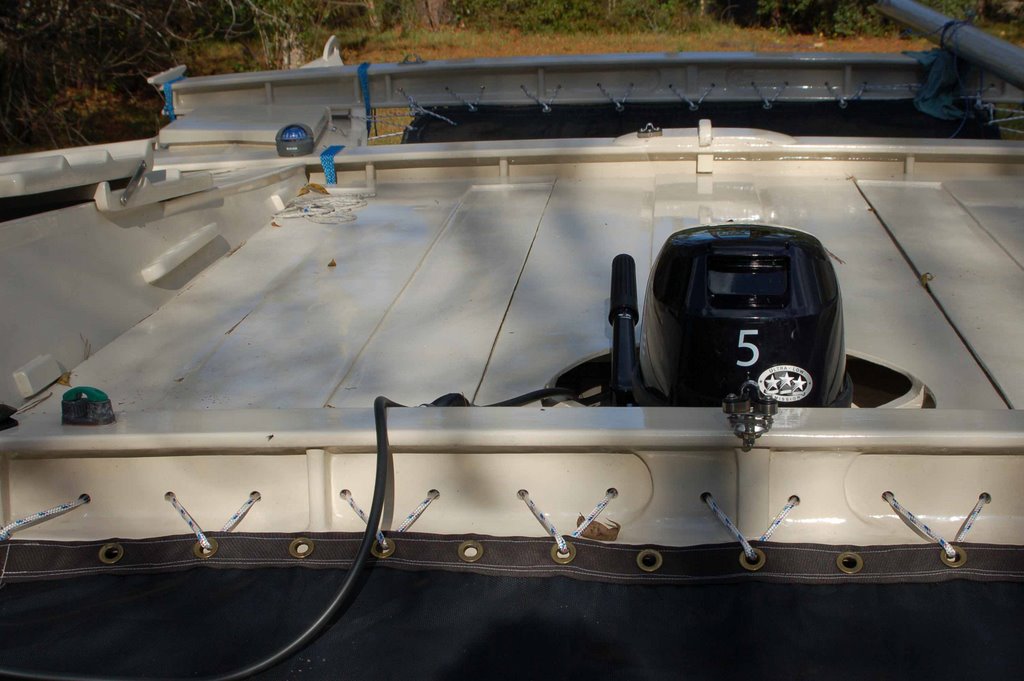
Today my new Nissan 4-stroke outboard arrived and to my relief I found that it fit perfectly into the motor mount built into the Tiki 21 bridgedeck by the original builder. This mount is lower than deck level, so the 20" shaft gets the prop well below the waterline and as you can see in the photographs, it does not protrude high above the deck level.
The Nissan/Tohatsu line of outboards come in a 4, 5 and 6 horsepower size, all three of which are the same weight: 55lb.s. I chose the 5 because this size comes with an external fuel tank and line. As I found out long ago on my Hitia 17 with it's 3.3 hp Evinrude, there is nothing more inconvenient than trying to fill a small internal fuel tank when it runs dry in choppy conditions and you end up spilling gasoline all over the engine and the decks. I also wanted forward, neutral and reverse gears, which this engine has, and the quiet, reliability, and fuel economy of a four-stroke.
I found the best price for this engine at www.onlineoutboards.com. I ordered it on Monday and it arrived today, shipped for free via FedEx.
Tuesday, November 07, 2006
About to be Sailing
 The new Jeckells mainsail looks great!
It won't be long now. After all this time I've finally located a place to keep Element in the water on the Mississippi Gulf Coast. It is a great location in the Biloxi area, not at a marina, but secure at a residential dock with easy access to the open waters of the sound and beyond.
Now I'm just finishing up little details like getting the trailer ready to move the boat and putting on a final coat of bottom paint. I'll also order a new outboard and some other gear this week. I'm planning to have a christening on dry land here where I've done the refit this Sunday, then move the boat to the coast to launch as soon as possible after that, depending on my work load and the availability of a couple of friends to help. We'll probably launch off the beach in Biloxi, using the 2-wheeled carts I built to roll the hulls into position across the sand for assembly at the water's edge.
Tiki 21 Interior
I've been asked by readers interested in the Tiki 21 to post some interior shots. There's not much to photograph inside a Tiki 21, but here are a couple of shots I took a few weeks ago after making the canvas storage pockets shown inside the hatches. I'll take some more soon with gear inside, such as sleeping bags, etc. There's lots of storage space under the bunk level in the hulls, as well as extra space forward and aft of the berth area. Each cabin has an open area of 12 linear feet at bunk level between watertight bulkheads.
 Port Hull at hatch entrance, showing canvas storage pockets for items like binoculars and handheld VHF radio that need to be accessible yet safe from going overboard.
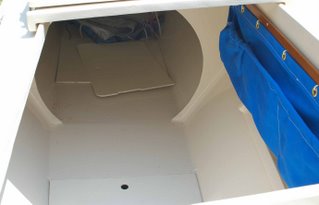
Looking forward into the port hull berth. The bunk is just wide enough for a standard 22" Thermarest self-inflating air mattress of the type used by backpackers. Loose hatch boards shown in the photo cover storage areas forward and aft. The bunks feel adequate even though narrow, because of the flaring hull sides that slope away from the sleeping position.
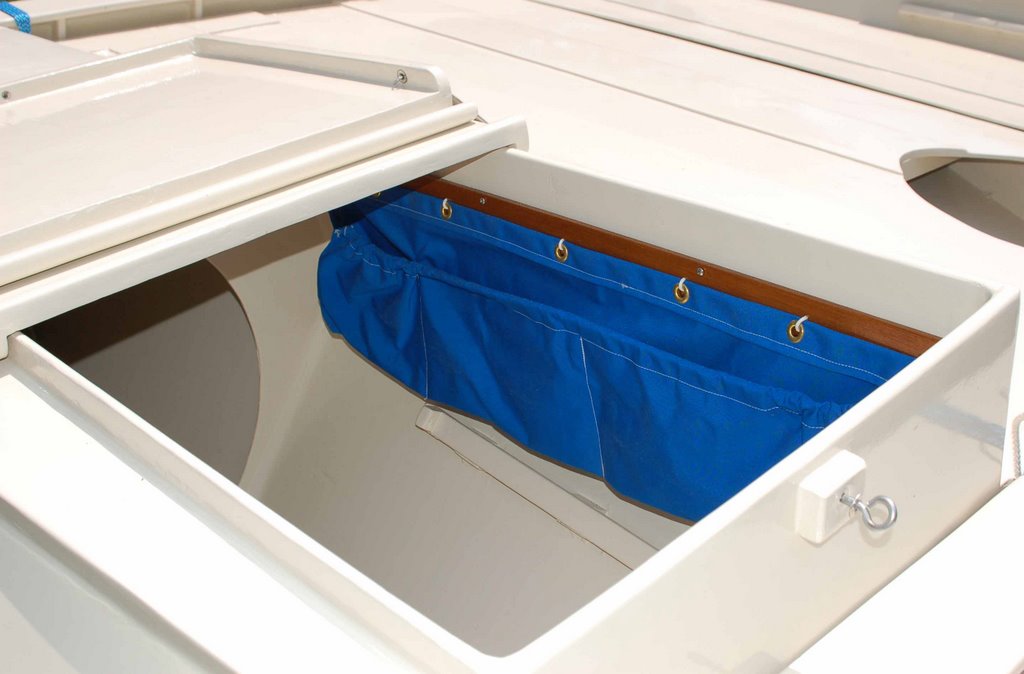 Port Hull at hatch entrance, showing canvas storage pockets for items like binoculars and handheld VHF radio that need to be accessible yet safe from going overboard.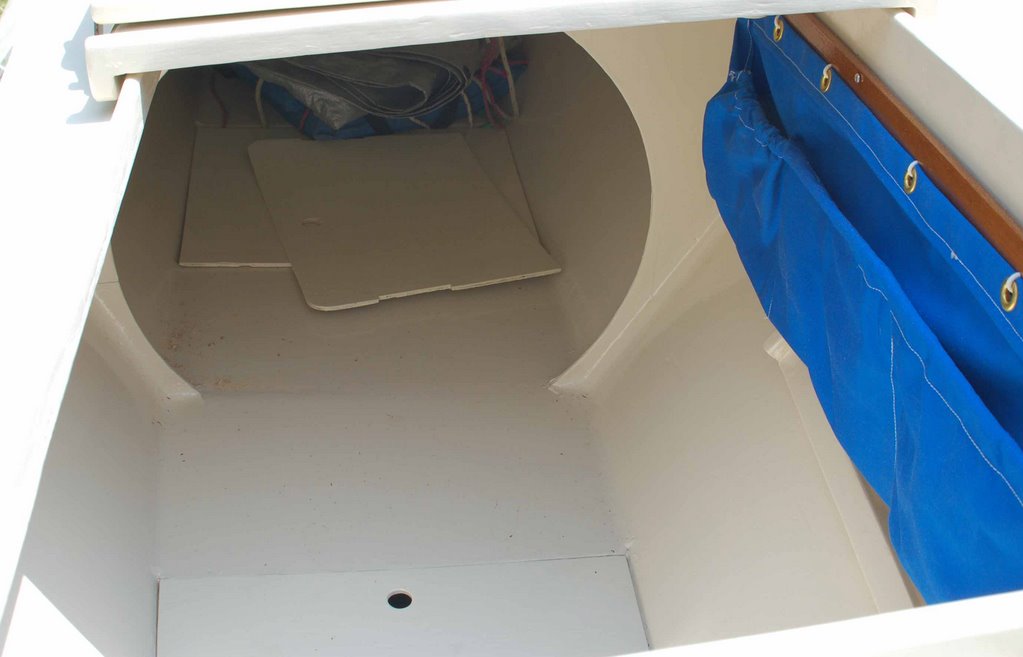
Looking forward into the port hull berth. The bunk is just wide enough for a standard 22" Thermarest self-inflating air mattress of the type used by backpackers. Loose hatch boards shown in the photo cover storage areas forward and aft. The bunks feel adequate even though narrow, because of the flaring hull sides that slope away from the sleeping position.
Thursday, October 19, 2006
The New Age of Sail
If you're a Wharram enthusiast or boatbuilder and you don't already read my other blog: Island Time Online, you'll definately want to check out this latest post: The New Age of Sail
Tuesday, October 17, 2006
Upcoming Wharram Rendezvous in Florida
I'm passing on the following email I received announcing the upcoming Wharram rendezvous in Hobe Sound, Florida, December 2006. Anyone needing information about this can inquire at this email address: floridawharramrendezvous@hotmail.com
I've deleted the home and cell telephone numbers included in this message since this post is on a public website, but you can get this information by emailing the above address. As of now, I am planning to be there. Whether I take a boat or not depends on whether I find a slip here for Element, or if she is still sitting on the trailer.
Greetings, Wharram Enthusiast!
You are being sent this email because you have expressed interest in
Wharram boats. This email is addressed to our email site, with all other names
going out under “bcc”. This is to ensure that the list remains
confidential. The document is both embedded in the email and provided
as an attachment…whatever works best for you. Same stuff.
You may have called about a Wharram for sale, you may be a member of
the Polynesian Catamaran Association (PCA-Sea People), you may be a Wharram
owner, prior owner or expect to be a future owner, you may be involved
in boats or boating products or services…or, we may have just screwed up
and put your name on the list for no apparent reason.
So, if you like Wharrams and would like to enjoy a weekend with Wharram
owners and enthusiasts, now is your chance!
The 2006 Florida Wharram Rendezvous is scheduled for the first weekend
in December (December 1, 2, 3) in Hobe Sound Florida. Hobe sound is near
Stuart on the Atlantic coast of Florida. We use a wonderful protected
anchorage at Peck Lake on the ICW that is only a few football fields
away from a sandy Atlantic beach.
We expect to have 5 or more Wharrams there. A Tiki 46, a few
Tangaroas, Tiki 26s and possibly others.
The rendezvous is always a fun event…nothing formally planned. Just
good people, nice chats, looking over boats, plans and pictures. Telling
good stories, horror stories and just tall tales. We usually start early
and go late…as long as the conversation is interesting.
Bring your pictures if you can’t bring your boat. If you can’t bring a
boat or pictures, then just bring yourself! We have even been known to
welcome “half boats” (monohulls).
And, there are rumors that we have tipped a few to toast the end of
hurricane season (horrors, no, never, not sailors…and definitely not
Wharram sailors!!!).
Simply stated, we have a lot of fun.
USEFUL INFORMATION:
Information about lodging: Heritage Inn (772-546-3600), Holiday Inn
(772-287-6200), Howard Johnson (772-287-3171), Ramada Inn
(772-287-6900),
Southwind Motel (772-287-0773), Ronny’s RV Ranch (772-287-2730).
Information about airports: Best bets are Palm Beach International or
St. Lucie (Ft. Pierce) International. Of course you can always get there
from Ft. Lauderdale, Miami, Orlando or Jacksonville but the drive is longer.
Information about restaurants: The area has the standard chain
restaurants and some good fish houses as well. However, they all require driving,
some a considerable distance. None are within walking distance. Unless you
have access to a car it is best to plan on bringing your food to the boats
(see below).
Information about other things to do: Since we can’t imagine why you
would want to do anything but enjoy the boats, good people and the nice
weather and water we haven’t included anything in this section. Actually, a
quick internet search will give you a lot of information about what is
available within an easy day’s drive (the zip code for this area is 33455).
Information about food and such (such=drinks!): We ask each person to
bring enough food and drink for themselves for the time they will be here.
Our approach is Dutch-treat, pot-luck.
THE WEATHER:
Yes, it’s Florida and its generally warm during the day. Highs in the
low 80’s is typical….BUT, it also can get into the 40’s-50’s in the
evenings and 20 knots of breeze is not uncommon. That can be a chilly combination.
Bring a pair of long pants and a sweater or hooded parker. Rain gear
is a good thing to have as well. The good news is that it’s the end of
hurricane season…we make no promises but, historically, there haven’t been many
‘canes after the end of November.
GETTING TO US:
Sailing in? We will be anchored in Peck Lake. Daymark 19 south of the
St. Lucie Inlet on the ICW. Latititude N27.06.924, Longitude W80.08.672.
We meet east of the daymark, good depth and good holding. Call Gene Perry
for local knowledge and more information if you need it. Coming by car? We run a dinghy shuttle to the boats from the launch ramp of Jimmie Graham Park. The park is in the town of Hobe Sound. To get to the Park from US Route 1 take Osprey Street East (by the Cumberland Farms Store). Go past the railroad tracks to the end, turn right onto Gomez
Road, ¼ mile to 8557 Gomez. That is the Park. Turn left into the park. Go to
the end of the road. There will be a Wharram sign in the launch ramp
area. The park has lighted boat ramps and docks and parking for trailers and
autos. Overnight parking is allowed. It is free and safe. Free and
clean restrooms too!
Please, call us in advance to come and get you. It takes about 15
minutes to get to the dock from the boats. There are usually a few dinghies available, so the wait will not be long.
WILL WE SAIL?
Maybe, maybe not. Depends on the weather, how many boats are there,
how many people show up, and many other factors. Generally, we have not
taken groups out to sail…but there is always a chance.
MORE INFORMATION:
If you need more information you may call Gene Perry (Tiki 26)
Dan Kunz (Tangaroa 36) Ann and Neville Clements’ (Tiki 46) You can also send a note to this email address. We will monitor e-mails every few days. E-mails will not be monitored from
approximately 7 days just before the event…so please use the phones at that point.
PLEASE PASS THIS INFORMATION ON TO ANYONE ELSE WHOM YOU THINK WOULD BE INTERESTED IN ATTENDING THIS EVENT. THEN FORWARD THEIR EMAIL ADDRESS ON TO US FOR THE MASTER LIST. THE EMAIL LIST WILL ONLY BE USED FOR WHARRAM EVENTS AND INFORMATION…WE WILL NOT GIVE AWAY OR SELL THE LIST. THANKS.
Our special thanks to SOUTHWINDS Magazine for their continued support
of boating and boaters in our beautiful southern waters. A notice of this
event will appear in both the November and December editions of
SOUTHWINDS. Pick up a copy…essential monthly reading for everyone in the South or
those who may eventually want to be in the South.
Hope to see you in December. Fair winds!
I've deleted the home and cell telephone numbers included in this message since this post is on a public website, but you can get this information by emailing the above address. As of now, I am planning to be there. Whether I take a boat or not depends on whether I find a slip here for Element, or if she is still sitting on the trailer.
Greetings, Wharram Enthusiast!
You are being sent this email because you have expressed interest in
Wharram boats. This email is addressed to our email site, with all other names
going out under “bcc”. This is to ensure that the list remains
confidential. The document is both embedded in the email and provided
as an attachment…whatever works best for you. Same stuff.
You may have called about a Wharram for sale, you may be a member of
the Polynesian Catamaran Association (PCA-Sea People), you may be a Wharram
owner, prior owner or expect to be a future owner, you may be involved
in boats or boating products or services…or, we may have just screwed up
and put your name on the list for no apparent reason.
So, if you like Wharrams and would like to enjoy a weekend with Wharram
owners and enthusiasts, now is your chance!
The 2006 Florida Wharram Rendezvous is scheduled for the first weekend
in December (December 1, 2, 3) in Hobe Sound Florida. Hobe sound is near
Stuart on the Atlantic coast of Florida. We use a wonderful protected
anchorage at Peck Lake on the ICW that is only a few football fields
away from a sandy Atlantic beach.
We expect to have 5 or more Wharrams there. A Tiki 46, a few
Tangaroas, Tiki 26s and possibly others.
The rendezvous is always a fun event…nothing formally planned. Just
good people, nice chats, looking over boats, plans and pictures. Telling
good stories, horror stories and just tall tales. We usually start early
and go late…as long as the conversation is interesting.
Bring your pictures if you can’t bring your boat. If you can’t bring a
boat or pictures, then just bring yourself! We have even been known to
welcome “half boats” (monohulls).
And, there are rumors that we have tipped a few to toast the end of
hurricane season (horrors, no, never, not sailors…and definitely not
Wharram sailors!!!).
Simply stated, we have a lot of fun.
USEFUL INFORMATION:
Information about lodging: Heritage Inn (772-546-3600), Holiday Inn
(772-287-6200), Howard Johnson (772-287-3171), Ramada Inn
(772-287-6900),
Southwind Motel (772-287-0773), Ronny’s RV Ranch (772-287-2730).
Information about airports: Best bets are Palm Beach International or
St. Lucie (Ft. Pierce) International. Of course you can always get there
from Ft. Lauderdale, Miami, Orlando or Jacksonville but the drive is longer.
Information about restaurants: The area has the standard chain
restaurants and some good fish houses as well. However, they all require driving,
some a considerable distance. None are within walking distance. Unless you
have access to a car it is best to plan on bringing your food to the boats
(see below).
Information about other things to do: Since we can’t imagine why you
would want to do anything but enjoy the boats, good people and the nice
weather and water we haven’t included anything in this section. Actually, a
quick internet search will give you a lot of information about what is
available within an easy day’s drive (the zip code for this area is 33455).
Information about food and such (such=drinks!): We ask each person to
bring enough food and drink for themselves for the time they will be here.
Our approach is Dutch-treat, pot-luck.
THE WEATHER:
Yes, it’s Florida and its generally warm during the day. Highs in the
low 80’s is typical….BUT, it also can get into the 40’s-50’s in the
evenings and 20 knots of breeze is not uncommon. That can be a chilly combination.
Bring a pair of long pants and a sweater or hooded parker. Rain gear
is a good thing to have as well. The good news is that it’s the end of
hurricane season…we make no promises but, historically, there haven’t been many
‘canes after the end of November.
GETTING TO US:
Sailing in? We will be anchored in Peck Lake. Daymark 19 south of the
St. Lucie Inlet on the ICW. Latititude N27.06.924, Longitude W80.08.672.
We meet east of the daymark, good depth and good holding. Call Gene Perry
for local knowledge and more information if you need it. Coming by car? We run a dinghy shuttle to the boats from the launch ramp of Jimmie Graham Park. The park is in the town of Hobe Sound. To get to the Park from US Route 1 take Osprey Street East (by the Cumberland Farms Store). Go past the railroad tracks to the end, turn right onto Gomez
Road, ¼ mile to 8557 Gomez. That is the Park. Turn left into the park. Go to
the end of the road. There will be a Wharram sign in the launch ramp
area. The park has lighted boat ramps and docks and parking for trailers and
autos. Overnight parking is allowed. It is free and safe. Free and
clean restrooms too!
Please, call us in advance to come and get you. It takes about 15
minutes to get to the dock from the boats. There are usually a few dinghies available, so the wait will not be long.
WILL WE SAIL?
Maybe, maybe not. Depends on the weather, how many boats are there,
how many people show up, and many other factors. Generally, we have not
taken groups out to sail…but there is always a chance.
MORE INFORMATION:
If you need more information you may call Gene Perry (Tiki 26)
Dan Kunz (Tangaroa 36) Ann and Neville Clements’ (Tiki 46) You can also send a note to this email address. We will monitor e-mails every few days. E-mails will not be monitored from
approximately 7 days just before the event…so please use the phones at that point.
PLEASE PASS THIS INFORMATION ON TO ANYONE ELSE WHOM YOU THINK WOULD BE INTERESTED IN ATTENDING THIS EVENT. THEN FORWARD THEIR EMAIL ADDRESS ON TO US FOR THE MASTER LIST. THE EMAIL LIST WILL ONLY BE USED FOR WHARRAM EVENTS AND INFORMATION…WE WILL NOT GIVE AWAY OR SELL THE LIST. THANKS.
Our special thanks to SOUTHWINDS Magazine for their continued support
of boating and boaters in our beautiful southern waters. A notice of this
event will appear in both the November and December editions of
SOUTHWINDS. Pick up a copy…essential monthly reading for everyone in the South or
those who may eventually want to be in the South.
Hope to see you in December. Fair winds!
Monday, October 16, 2006
Element is Ready to Relaunch
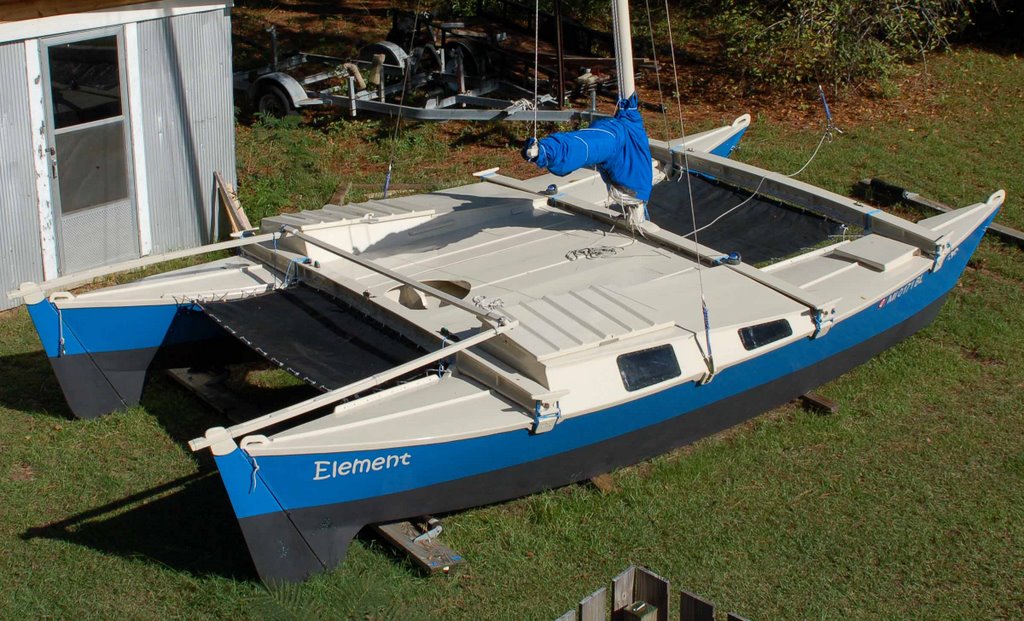
Element assembled, rigged and ready to launch....
Those of you following this blog have probably assumed I've not been working on Element, but in fact I've been steadily plugging away at finishing details, including reinstalling all the hardware after the paint job, replacing and setting up the running rigging, and making some custom canvas items like interior storage pockets and a rear trampoline. The only thing the boat lacks at this point is the outboard engine, which I will be buying shortly before launching. I'm also overhauling the trailer and getting it ready for the trip to the coast, which is at least 2 hours away depending on where I decide to launch.
I would have already been sailing by now if not for the difficulty of finding a place to dock the boat on the Mississippi Gulf coast. Most of the marinas there were destroyed or badly damaged by Katrina, and those that were not are full. I'm on the waiting list at a couple of potential marinas, but so far I have not found a place to dock the boat that is convenient to getting out in the open Gulf. Although the Tiki 21 is a trailerable catamaran, it's not a trailer-sailor in the sense that you can feasibly drive 2 hours, spend about that long assembling it, go sailing for a few hours, then repeat the process in reverse. For me, keeping the boat in the water is the only way to go. I plan to have it set up and fully equipped for multi-day beachcruising adventures, so that when I drive down to the coast to board it, all I'll have to do is load on the food and water for whatever trip I've planned and cast off the lines.
I'm of course getting anxious to sail this boat, so if I don't find an ideal dock space soon, I'll explore the option of a marina in nearby Louisiana or Alabama, where there are more slips available.
Sunday, July 16, 2006
Tiki 21 Paint Job Nearly Completed
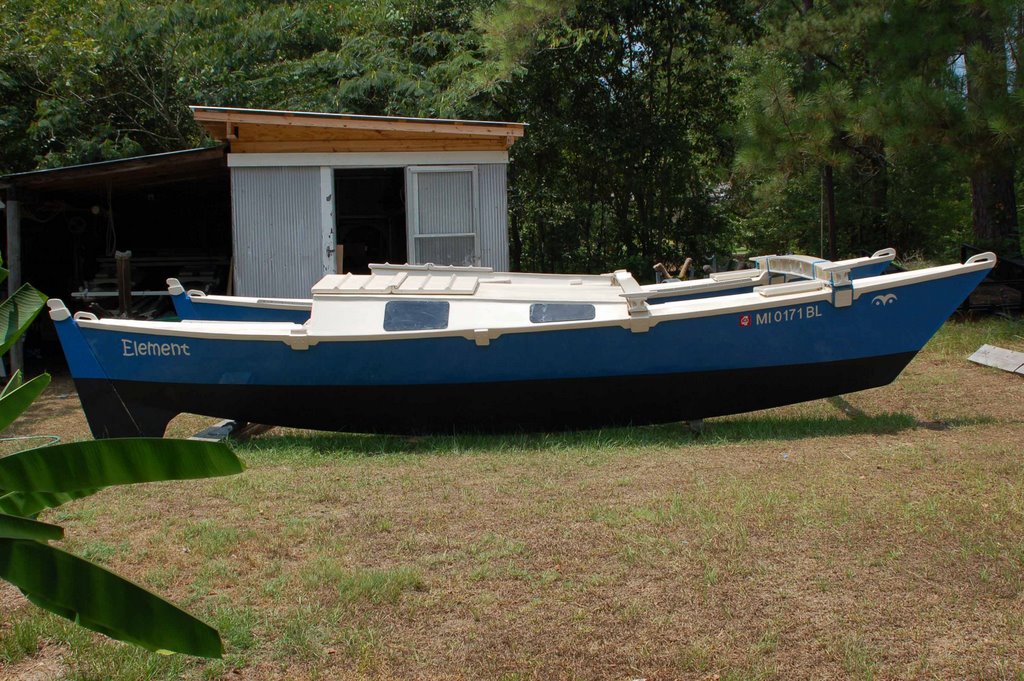
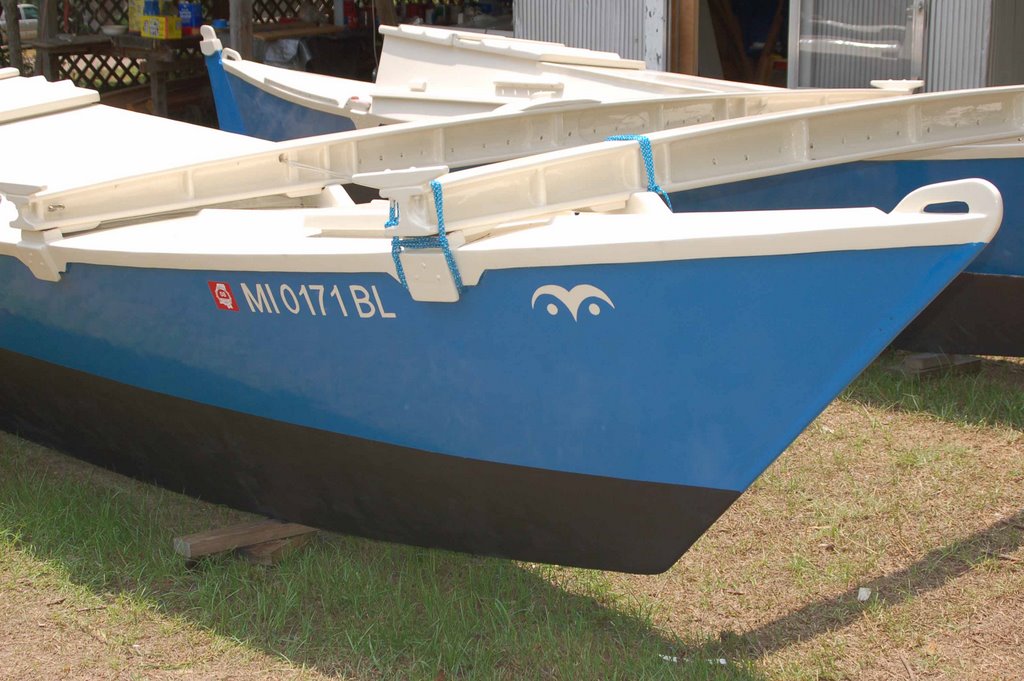
 (Click on the photos to view larger image)
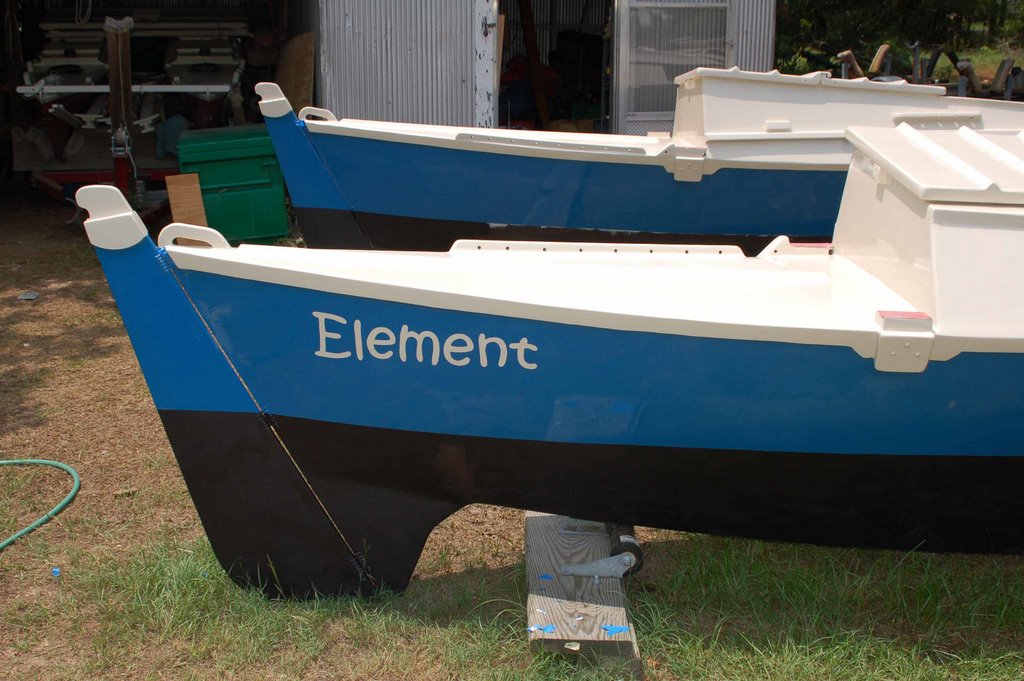
Here's some shots I took today of the two hulls, showing the graphics and fresh topside, deck, and bottom paint. I used the same Interlux "Ocean Blue" the previous owner used on the hull topsides, but changed the deck color to Easypoxy "Sandtone" since it is much easier to keep clean and easier on the eyes in the bright sun than pure white. I've had good results with this paint on the decks of Intensity and Segundo Vez, getting about 2-3 years out of it in the intense Gulf coast sunlight.
Rather than using computer-generated plastic graphics as I have done in the past, I wanted to paint the name and registration numbers on this time, as well as the Wharram logo on the bows. I wanted to paint it because I wanted it to match the decks exactly, and because painted graphics can be touched up when damaged, as will surely happen at some point when the hull is banged against a dock, dinghy, or kayak. To get a consistant pattern on both sides, I first drew the graphics on a sheet of semi-transparent tracing paper, then covered the hull area where they would be applied with 3M blue masking tape. I transfered the paper pattern to the tape using carbon paper, then cut out the tape along the transfered lines using an Xacto knife. Three coats of the Easypoxy Sandtone color were applied, then the tape was pulled. I'm quite pleased with the result, and won't be buying computer-generated graphics again.
All the decks, hatch covers and cabin sides need one final coat of Sandtone, and the mast and gaff has yet to be painted. After that, I'll begin reinstalling hardware, then step the mast and set up all the new rigging that I've made.
Monday, June 19, 2006
Tiki 21 Refit Details
I knew there was work to be done on this boat when I bought it, but even so, I thought I would be sailing it by now. As it turned out, the refit turned out to be an extensive one, as many of the necessary repairs revealed other problems I could not have seen until I started sanding through the paint and replacing rotten wood, etc. Some of these problems were the result of neglect; others were simply poor building practices on the part of the original builder. Many of the projects I’ve taken on and the changes I’ve made might not seem necessary to other Tiki 21 sailors, but rather than get in a hurry just to get on the water, I wanted to do everything I could to make this boat as strong and seaworthy as possible, and to make it look as good as possible considering what I had to work with. Each decision in the refit was made with long-term durability in mind, and with thoughts to making the boat ready for extended coastal voyaging.
Posting the details of the repairs here might help other Tiki 21 owners who are facing a similar job, or might help builders of new Tiki 21 catamarans make the right decisions regarding particular tasks so that future problems can be avoided. A lot of these problems could be avoided by using higher quality plywood and by sheathing EVERY exposed plywood surface in fiberglass cloth and epoxy.
Here is the list of jobs completed so far:
Built two strong dollies with pneumatic tires so that each hull could be moved when off the trailer and handled by one person.
Stripped the hardware and wooden end cleats off the three crossbeams and sanded them down to the bare wood. The previous owner had done a poor job of varnishing the top plates, despite discoloration in the wood from water intrusion. I cut off all the beam ends at the proper angle to match the curve of the deck, made new end cleats of teak installed with through bolts bedded in 3M 4200, and painted all parts of the beams and cleats the with the same Interlux Brightside “Off White” I will use for the decks.
Stripped and sanded the varnished mast down to the bare wood and filled minor cracks in the laminations. The builder used finger-jointed fir for the mast parts, so I decided to sheath the entire mast in 6-oz. fiberglass to make delamination less likely and to add some strength. After glassing the entire mast, including the crane and foot, I painted it all Off White. The gaff was also painted Off White.
Chiseled off the rotten trampoline rails on both port and starboard foredecks, and made new, stronger ones out of teak. I only used teak because I had it on hand. There will be no brightwork on this boat, so even teak parts such as this will be painted to blend in with the decks.
Chiseled off rotten bridgedeck support rails on the port and starboard inboard cabin sides and made new ones out of Douglas fir. I also replaced the jib sheet lead blocks above the deck support rails with new ones made of teak.
Discovered extensive areas of rot in the sheer stringers where the decks are nailed to the hulls on both the port and starboard hulls, both on the inboard and outboard sides. Chiseled all soft and wet sections out of these fir stringers and scarfed in new sections using Douglas fir and epoxy thickened with wood flour and silica. All new areas here were faired in to match the existing stringers with several rounds of sanding and filling. Then the repaired areas were all glassed with 6-oz. cloth which was also faired into existing decks.
Built up the hatch coamings on the foredeck hatches, and added a wide flange at the top to create a better sealing surface to make the hatches more watertight. I also added a wooden “dam” in front of each bow hatch to deflect green water coming over the deck while going to windward in the rough stuff. This should divert a lot of the water that otherwise would be forced under the hatch seals.
I did extensive sanding and fairing of poorly-finished deck and cabin-side surfaces left by the original builder. Fairing was done with epoxy mixed with West System microlight fairing compound and silica.
Laid out symmetrical patches of non-skid areas on the fore and aft decks of each hull, the cabin tops, and the middle bridge deck pieces. Non-skid surface was applied by mixing non-skid compound with the deck paint and applying in the taped-off areas with a 3-inch foam roller.
The beam and shroud lashing cleats were improperly placed on the sheer stringer by the original builder, not leaving enough overhang to get the full number of turns off lashing rope specified in the plans. To correct this problem, I squared off the bottom edges of all these cleats with a belt sander, then laminated blocks of solid mahogany to the bottom edges to get another half-inch of overhang. All this had to be reshaped and rounded over to avoid chafing the lashing lines, then epoxy coated, primed and painted.
Replaced the beam lashing lines with new Dacron 3’16” line by Sampson, using the solid blue color to match the hull topsides.
Rebuilt the two-piece main companionway hatches for each hull by cutting out rotten wood in the overhang edges and scarfing in new sections. Hatches were showing bad signs of checking, since they were made of Douglas fir marine plywood but were only epoxy coated and painted rather than sheathed in fiberglass. Sanded all these down to bare wood and properly sheathed, faired and painted them Off White to match the decks.
Bow storage compartment hatches were also repaired and sheathed in fiberglass and painted. All hatches were also stripped and painted on the inside, in preparation for new foam hatch seal tape for a better seal.
I’m not sure why so many builders think they know more than Wharram, but like many of them, the builder of my Tiki hung the rudders on gudgeons and pintles, rather than lashing them on as per plans. This hardware was also poorly bedded in the hull with silicone, even below the waterline! The rudders, like the hatch covers, were not sheathed in glass, and were also checking. I removed the hardware, took them to the bare wood, filled the holes, and sheathed them in 6-oz. glass. The rudders were then primed and drilled for the lashings, which were done with 1/8” Dacron cord, sealed with epoxy, primed and painted. This lashing system will last for many, many years, as other Tiki owners will attest. It’s quieter, smoother, and leaves no gap between the trailing edge of the sternpost and the leading edge of the rudder to create turbulence at high speed.
The tillers and tiller bar were also finished bright, but not done very well, so I sanded these down and painted them Off White as well. The reinforcing bindings of 1/8-inch Dacron were replaced, sealed in epoxy and painted as well. The goal is no brightwork, no time spent maintaining finishes when this boat goes back in the water – at least not until the paint needs attention again.
Extensive work was needed in the interior to make the boat presentable and habitable for cruising. The builder had painted the interior white, but either used paint incompatible with epoxy or did not properly clean and prep the surfaces before painting. The port hull was not so bad, mainly needing cleaning and sanding before new paint could be applied. The starboard hull was much worse; most of the paint in the cabin and in the below bunks lockers was peeling and flaking. This required extensive scraping and sanding in the confines of the narrow hulls. Some epoxy fairing was also required before all interior surfaces were coated with high-build primer and then painted with Petit Easypoxy, in the Sandtone color, a pleasant, earthy color a few shades darker than the reflective Off White chosen for the decks. All interior storage hatch covers were also painted top and bottom with Sandtone.
All the standing rigging was replaced using 3/16” 7-19 stainless steel rigging wire. Nicropress sleeves and stainless thimbles were used to make the eyes and the top shroud loops at the mast head are padded where they cross the mast by 1’4” I.D. rubber fuel line hose over the wire to prevent digging into the wood.
A new suit of Jeckells sails was purchased from a Tiki 21 builder who decided not to complete the project. Sails include a main with two reef points and working jib with one reef point.
All this work on the decks, rudders, cabin sides and sheer stringers off course makes it necessary to paint the hull topsides. The next step is to sand and prep the topsides and repaint them. I’ll use the same Interlux Brightside “Ocean Blue” that the previous owner chose for the topsides, as it is a nice combination with the Off White deck color. After the topsides are repainted up to the bottom of the sheer stringers, all the decks will be final coated in Off White, as well as the beams, bridge deck parts, gaff, tillers, tiller bar and hatch covers. The last thing to paint will be a fresh coat of black bottom paint below the waterline.
The new name Element will be put on each hull, as well as new registration numbers, using either vinyl graphics or hand painting.
Other tasks prior to launching will include stepping the mast and adjusting all the new standing rigging, replacing the halyards, reinstalling halyard and sheeting cleats, etc., setting up the mainsheet traveler, tiller control lines, ground tackle, etc., and rigging the new sails. I’ll reinstall the cloth storage pockets that came in the cabins, and add more gear hammocks and storage systems, set up a portable galley, install a compass on each cabin top so the boat can be steered from either hull, install portable navigation lights for now, until I decide about an onboard electrical system, and purchase a new Nissan four-stroke 4 hp outboard with forward, neutral and reverse.
Before I can move the boat back to the Gulf coast and relaunch, the trailer will need some attention, including repacking the wheel bearings, redesigning the hull-carrying cradles and making some steel extension bars so I can hopefully assemble the boat on the trailer single-handed and launch it by backing it down a conventional boat ramp.
Will it be worth all this? I think so, based on my previous experience with my smaller Wharram Hitia 17 and all the feedback I’ve gotten from other Tiki 21 and Tiki 26 owners. Wharram catamarans are indeed simple boats, but anyone who has built or rebuilt one know that there are a lot of parts to make, fair and paint, and maintain. The best policy is to use the best of materials and the highest possible quality of craftsmanship you are capable of to insure a minimum of the kind of work I’ve had to do here. Despite all this, it could be much worse, as some owners have found. At least the main hulls and decks of my boat were well-built and I have found no rot or other problems there and in fact no bad plywood anywhere. Most of the problems are in the little pieces of solid wood that are so hard to properly seal.
More to come as Element gets ready to sail again….
Posting the details of the repairs here might help other Tiki 21 owners who are facing a similar job, or might help builders of new Tiki 21 catamarans make the right decisions regarding particular tasks so that future problems can be avoided. A lot of these problems could be avoided by using higher quality plywood and by sheathing EVERY exposed plywood surface in fiberglass cloth and epoxy.
Here is the list of jobs completed so far:
Built two strong dollies with pneumatic tires so that each hull could be moved when off the trailer and handled by one person.
Stripped the hardware and wooden end cleats off the three crossbeams and sanded them down to the bare wood. The previous owner had done a poor job of varnishing the top plates, despite discoloration in the wood from water intrusion. I cut off all the beam ends at the proper angle to match the curve of the deck, made new end cleats of teak installed with through bolts bedded in 3M 4200, and painted all parts of the beams and cleats the with the same Interlux Brightside “Off White” I will use for the decks.
Stripped and sanded the varnished mast down to the bare wood and filled minor cracks in the laminations. The builder used finger-jointed fir for the mast parts, so I decided to sheath the entire mast in 6-oz. fiberglass to make delamination less likely and to add some strength. After glassing the entire mast, including the crane and foot, I painted it all Off White. The gaff was also painted Off White.
Chiseled off the rotten trampoline rails on both port and starboard foredecks, and made new, stronger ones out of teak. I only used teak because I had it on hand. There will be no brightwork on this boat, so even teak parts such as this will be painted to blend in with the decks.
Chiseled off rotten bridgedeck support rails on the port and starboard inboard cabin sides and made new ones out of Douglas fir. I also replaced the jib sheet lead blocks above the deck support rails with new ones made of teak.
Discovered extensive areas of rot in the sheer stringers where the decks are nailed to the hulls on both the port and starboard hulls, both on the inboard and outboard sides. Chiseled all soft and wet sections out of these fir stringers and scarfed in new sections using Douglas fir and epoxy thickened with wood flour and silica. All new areas here were faired in to match the existing stringers with several rounds of sanding and filling. Then the repaired areas were all glassed with 6-oz. cloth which was also faired into existing decks.
Built up the hatch coamings on the foredeck hatches, and added a wide flange at the top to create a better sealing surface to make the hatches more watertight. I also added a wooden “dam” in front of each bow hatch to deflect green water coming over the deck while going to windward in the rough stuff. This should divert a lot of the water that otherwise would be forced under the hatch seals.
I did extensive sanding and fairing of poorly-finished deck and cabin-side surfaces left by the original builder. Fairing was done with epoxy mixed with West System microlight fairing compound and silica.
Laid out symmetrical patches of non-skid areas on the fore and aft decks of each hull, the cabin tops, and the middle bridge deck pieces. Non-skid surface was applied by mixing non-skid compound with the deck paint and applying in the taped-off areas with a 3-inch foam roller.
The beam and shroud lashing cleats were improperly placed on the sheer stringer by the original builder, not leaving enough overhang to get the full number of turns off lashing rope specified in the plans. To correct this problem, I squared off the bottom edges of all these cleats with a belt sander, then laminated blocks of solid mahogany to the bottom edges to get another half-inch of overhang. All this had to be reshaped and rounded over to avoid chafing the lashing lines, then epoxy coated, primed and painted.
Replaced the beam lashing lines with new Dacron 3’16” line by Sampson, using the solid blue color to match the hull topsides.
Rebuilt the two-piece main companionway hatches for each hull by cutting out rotten wood in the overhang edges and scarfing in new sections. Hatches were showing bad signs of checking, since they were made of Douglas fir marine plywood but were only epoxy coated and painted rather than sheathed in fiberglass. Sanded all these down to bare wood and properly sheathed, faired and painted them Off White to match the decks.
Bow storage compartment hatches were also repaired and sheathed in fiberglass and painted. All hatches were also stripped and painted on the inside, in preparation for new foam hatch seal tape for a better seal.
I’m not sure why so many builders think they know more than Wharram, but like many of them, the builder of my Tiki hung the rudders on gudgeons and pintles, rather than lashing them on as per plans. This hardware was also poorly bedded in the hull with silicone, even below the waterline! The rudders, like the hatch covers, were not sheathed in glass, and were also checking. I removed the hardware, took them to the bare wood, filled the holes, and sheathed them in 6-oz. glass. The rudders were then primed and drilled for the lashings, which were done with 1/8” Dacron cord, sealed with epoxy, primed and painted. This lashing system will last for many, many years, as other Tiki owners will attest. It’s quieter, smoother, and leaves no gap between the trailing edge of the sternpost and the leading edge of the rudder to create turbulence at high speed.
The tillers and tiller bar were also finished bright, but not done very well, so I sanded these down and painted them Off White as well. The reinforcing bindings of 1/8-inch Dacron were replaced, sealed in epoxy and painted as well. The goal is no brightwork, no time spent maintaining finishes when this boat goes back in the water – at least not until the paint needs attention again.
Extensive work was needed in the interior to make the boat presentable and habitable for cruising. The builder had painted the interior white, but either used paint incompatible with epoxy or did not properly clean and prep the surfaces before painting. The port hull was not so bad, mainly needing cleaning and sanding before new paint could be applied. The starboard hull was much worse; most of the paint in the cabin and in the below bunks lockers was peeling and flaking. This required extensive scraping and sanding in the confines of the narrow hulls. Some epoxy fairing was also required before all interior surfaces were coated with high-build primer and then painted with Petit Easypoxy, in the Sandtone color, a pleasant, earthy color a few shades darker than the reflective Off White chosen for the decks. All interior storage hatch covers were also painted top and bottom with Sandtone.
All the standing rigging was replaced using 3/16” 7-19 stainless steel rigging wire. Nicropress sleeves and stainless thimbles were used to make the eyes and the top shroud loops at the mast head are padded where they cross the mast by 1’4” I.D. rubber fuel line hose over the wire to prevent digging into the wood.
A new suit of Jeckells sails was purchased from a Tiki 21 builder who decided not to complete the project. Sails include a main with two reef points and working jib with one reef point.
All this work on the decks, rudders, cabin sides and sheer stringers off course makes it necessary to paint the hull topsides. The next step is to sand and prep the topsides and repaint them. I’ll use the same Interlux Brightside “Ocean Blue” that the previous owner chose for the topsides, as it is a nice combination with the Off White deck color. After the topsides are repainted up to the bottom of the sheer stringers, all the decks will be final coated in Off White, as well as the beams, bridge deck parts, gaff, tillers, tiller bar and hatch covers. The last thing to paint will be a fresh coat of black bottom paint below the waterline.
The new name Element will be put on each hull, as well as new registration numbers, using either vinyl graphics or hand painting.
Other tasks prior to launching will include stepping the mast and adjusting all the new standing rigging, replacing the halyards, reinstalling halyard and sheeting cleats, etc., setting up the mainsheet traveler, tiller control lines, ground tackle, etc., and rigging the new sails. I’ll reinstall the cloth storage pockets that came in the cabins, and add more gear hammocks and storage systems, set up a portable galley, install a compass on each cabin top so the boat can be steered from either hull, install portable navigation lights for now, until I decide about an onboard electrical system, and purchase a new Nissan four-stroke 4 hp outboard with forward, neutral and reverse.
Before I can move the boat back to the Gulf coast and relaunch, the trailer will need some attention, including repacking the wheel bearings, redesigning the hull-carrying cradles and making some steel extension bars so I can hopefully assemble the boat on the trailer single-handed and launch it by backing it down a conventional boat ramp.
Will it be worth all this? I think so, based on my previous experience with my smaller Wharram Hitia 17 and all the feedback I’ve gotten from other Tiki 21 and Tiki 26 owners. Wharram catamarans are indeed simple boats, but anyone who has built or rebuilt one know that there are a lot of parts to make, fair and paint, and maintain. The best policy is to use the best of materials and the highest possible quality of craftsmanship you are capable of to insure a minimum of the kind of work I’ve had to do here. Despite all this, it could be much worse, as some owners have found. At least the main hulls and decks of my boat were well-built and I have found no rot or other problems there and in fact no bad plywood anywhere. Most of the problems are in the little pieces of solid wood that are so hard to properly seal.
More to come as Element gets ready to sail again….
Subscribe to:
Posts (Atom)

