I knew there was work to be done on this boat when I bought it, but even so, I thought I would be sailing it by now. As it turned out, the refit turned out to be an extensive one, as many of the necessary repairs revealed other problems I could not have seen until I started sanding through the paint and replacing rotten wood, etc. Some of these problems were the result of neglect; others were simply poor building practices on the part of the original builder. Many of the projects I’ve taken on and the changes I’ve made might not seem necessary to other Tiki 21 sailors, but rather than get in a hurry just to get on the water, I wanted to do everything I could to make this boat as strong and seaworthy as possible, and to make it look as good as possible considering what I had to work with. Each decision in the refit was made with long-term durability in mind, and with thoughts to making the boat ready for extended coastal voyaging.
Posting the details of the repairs here might help other Tiki 21 owners who are facing a similar job, or might help builders of new Tiki 21 catamarans make the right decisions regarding particular tasks so that future problems can be avoided. A lot of these problems could be avoided by using higher quality plywood and by sheathing EVERY exposed plywood surface in fiberglass cloth and epoxy.
Here is the list of jobs completed so far:
Built two strong dollies with pneumatic tires so that each hull could be moved when off the trailer and handled by one person.
Stripped the hardware and wooden end cleats off the three crossbeams and sanded them down to the bare wood. The previous owner had done a poor job of varnishing the top plates, despite discoloration in the wood from water intrusion. I cut off all the beam ends at the proper angle to match the curve of the deck, made new end cleats of teak installed with through bolts bedded in 3M 4200, and painted all parts of the beams and cleats the with the same Interlux Brightside “Off White” I will use for the decks.
Stripped and sanded the varnished mast down to the bare wood and filled minor cracks in the laminations. The builder used finger-jointed fir for the mast parts, so I decided to sheath the entire mast in 6-oz. fiberglass to make delamination less likely and to add some strength. After glassing the entire mast, including the crane and foot, I painted it all Off White. The gaff was also painted Off White.
Chiseled off the rotten trampoline rails on both port and starboard foredecks, and made new, stronger ones out of teak. I only used teak because I had it on hand. There will be no brightwork on this boat, so even teak parts such as this will be painted to blend in with the decks.
Chiseled off rotten bridgedeck support rails on the port and starboard inboard cabin sides and made new ones out of Douglas fir. I also replaced the jib sheet lead blocks above the deck support rails with new ones made of teak.
Discovered extensive areas of rot in the sheer stringers where the decks are nailed to the hulls on both the port and starboard hulls, both on the inboard and outboard sides. Chiseled all soft and wet sections out of these fir stringers and scarfed in new sections using Douglas fir and epoxy thickened with wood flour and silica. All new areas here were faired in to match the existing stringers with several rounds of sanding and filling. Then the repaired areas were all glassed with 6-oz. cloth which was also faired into existing decks.
Built up the hatch coamings on the foredeck hatches, and added a wide flange at the top to create a better sealing surface to make the hatches more watertight. I also added a wooden “dam” in front of each bow hatch to deflect green water coming over the deck while going to windward in the rough stuff. This should divert a lot of the water that otherwise would be forced under the hatch seals.
I did extensive sanding and fairing of poorly-finished deck and cabin-side surfaces left by the original builder. Fairing was done with epoxy mixed with West System microlight fairing compound and silica.
Laid out symmetrical patches of non-skid areas on the fore and aft decks of each hull, the cabin tops, and the middle bridge deck pieces. Non-skid surface was applied by mixing non-skid compound with the deck paint and applying in the taped-off areas with a 3-inch foam roller.
The beam and shroud lashing cleats were improperly placed on the sheer stringer by the original builder, not leaving enough overhang to get the full number of turns off lashing rope specified in the plans. To correct this problem, I squared off the bottom edges of all these cleats with a belt sander, then laminated blocks of solid mahogany to the bottom edges to get another half-inch of overhang. All this had to be reshaped and rounded over to avoid chafing the lashing lines, then epoxy coated, primed and painted.
Replaced the beam lashing lines with new Dacron 3’16” line by Sampson, using the solid blue color to match the hull topsides.
Rebuilt the two-piece main companionway hatches for each hull by cutting out rotten wood in the overhang edges and scarfing in new sections. Hatches were showing bad signs of checking, since they were made of Douglas fir marine plywood but were only epoxy coated and painted rather than sheathed in fiberglass. Sanded all these down to bare wood and properly sheathed, faired and painted them Off White to match the decks.
Bow storage compartment hatches were also repaired and sheathed in fiberglass and painted. All hatches were also stripped and painted on the inside, in preparation for new foam hatch seal tape for a better seal.
I’m not sure why so many builders think they know more than Wharram, but like many of them, the builder of my Tiki hung the rudders on gudgeons and pintles, rather than lashing them on as per plans. This hardware was also poorly bedded in the hull with silicone, even below the waterline! The rudders, like the hatch covers, were not sheathed in glass, and were also checking. I removed the hardware, took them to the bare wood, filled the holes, and sheathed them in 6-oz. glass. The rudders were then primed and drilled for the lashings, which were done with 1/8” Dacron cord, sealed with epoxy, primed and painted. This lashing system will last for many, many years, as other Tiki owners will attest. It’s quieter, smoother, and leaves no gap between the trailing edge of the sternpost and the leading edge of the rudder to create turbulence at high speed.
The tillers and tiller bar were also finished bright, but not done very well, so I sanded these down and painted them Off White as well. The reinforcing bindings of 1/8-inch Dacron were replaced, sealed in epoxy and painted as well. The goal is no brightwork, no time spent maintaining finishes when this boat goes back in the water – at least not until the paint needs attention again.
Extensive work was needed in the interior to make the boat presentable and habitable for cruising. The builder had painted the interior white, but either used paint incompatible with epoxy or did not properly clean and prep the surfaces before painting. The port hull was not so bad, mainly needing cleaning and sanding before new paint could be applied. The starboard hull was much worse; most of the paint in the cabin and in the below bunks lockers was peeling and flaking. This required extensive scraping and sanding in the confines of the narrow hulls. Some epoxy fairing was also required before all interior surfaces were coated with high-build primer and then painted with Petit Easypoxy, in the Sandtone color, a pleasant, earthy color a few shades darker than the reflective Off White chosen for the decks. All interior storage hatch covers were also painted top and bottom with Sandtone.
All the standing rigging was replaced using 3/16” 7-19 stainless steel rigging wire. Nicropress sleeves and stainless thimbles were used to make the eyes and the top shroud loops at the mast head are padded where they cross the mast by 1’4” I.D. rubber fuel line hose over the wire to prevent digging into the wood.
A new suit of Jeckells sails was purchased from a Tiki 21 builder who decided not to complete the project. Sails include a main with two reef points and working jib with one reef point.
All this work on the decks, rudders, cabin sides and sheer stringers off course makes it necessary to paint the hull topsides. The next step is to sand and prep the topsides and repaint them. I’ll use the same Interlux Brightside “Ocean Blue” that the previous owner chose for the topsides, as it is a nice combination with the Off White deck color. After the topsides are repainted up to the bottom of the sheer stringers, all the decks will be final coated in Off White, as well as the beams, bridge deck parts, gaff, tillers, tiller bar and hatch covers. The last thing to paint will be a fresh coat of black bottom paint below the waterline.
The new name Element will be put on each hull, as well as new registration numbers, using either vinyl graphics or hand painting.
Other tasks prior to launching will include stepping the mast and adjusting all the new standing rigging, replacing the halyards, reinstalling halyard and sheeting cleats, etc., setting up the mainsheet traveler, tiller control lines, ground tackle, etc., and rigging the new sails. I’ll reinstall the cloth storage pockets that came in the cabins, and add more gear hammocks and storage systems, set up a portable galley, install a compass on each cabin top so the boat can be steered from either hull, install portable navigation lights for now, until I decide about an onboard electrical system, and purchase a new Nissan four-stroke 4 hp outboard with forward, neutral and reverse.
Before I can move the boat back to the Gulf coast and relaunch, the trailer will need some attention, including repacking the wheel bearings, redesigning the hull-carrying cradles and making some steel extension bars so I can hopefully assemble the boat on the trailer single-handed and launch it by backing it down a conventional boat ramp.
Will it be worth all this? I think so, based on my previous experience with my smaller Wharram Hitia 17 and all the feedback I’ve gotten from other Tiki 21 and Tiki 26 owners. Wharram catamarans are indeed simple boats, but anyone who has built or rebuilt one know that there are a lot of parts to make, fair and paint, and maintain. The best policy is to use the best of materials and the highest possible quality of craftsmanship you are capable of to insure a minimum of the kind of work I’ve had to do here. Despite all this, it could be much worse, as some owners have found. At least the main hulls and decks of my boat were well-built and I have found no rot or other problems there and in fact no bad plywood anywhere. Most of the problems are in the little pieces of solid wood that are so hard to properly seal.
More to come as Element gets ready to sail again….
Monday, June 19, 2006

Thursday, April 06, 2006
New Jeckells Sails
As most sailors know, nothing improves a boat's performance more than a new set of sails. I had considered ordering new sails for Element, but thought I would wait until after I had sailed the boat awhile. The sails that came with it are in fairly good shape, but do show some wear and some unremovable rust stains from being submerged in the storm surge of Katrina at the previous owner's house.
Since I often check the various Wharram-related forums and classified ads available online, I found a deal from a fellow who had Tiki 21 plans, new Jeckells sails, and all the hull parts cut from BS 1088 Meranti. I bought the package and just the other day the sails and the new plan set arrived.
These sails are great. Jeckells, an English sailmaker, has been in business since the early 1800s, and they are Wharram's recommened sailmaker for all his designs. This set of working sails includes the main with 2 reefs, and a jib with a single reef. Having this many reefing options is essential for the kind of sailing I intend to do with this Tiki.
I'm still not sure what I'm going to do with the wood hull parts that are included. I'm waiting on a shipping quote to see how much it will cost to get them to me. I might keep them on hand for future use or sell them to someone interested in building their own Tiki.
Sunday, March 05, 2006
A Tiki 21 Rescued a Second Time
 In the backyard where the refit will be done, after trailering inland from the coast....

One of the first steps was to unload the hulls off the trailer and assemble the boat, to see what I had to work with and what work needed to be done.
This Tiki 21 was built by an amateur builder in Texas in about 1989 to 1990, near as I can tell from the receipts for the plans, various materials, sails and registration papers for the boat and trailer. The couple that I bought it from acquired it several years ago and completed the first refit around 2002. They said it had been badly neglected when they found it and that it took them a couple of years to get it back to sailing condition. Because of this, when they relaunched it, they christened the boat Ho'opakele, an Hawaiian name meaning "Rescued."
Apparently, this is a luckly little catamaran, as it has now been rescued once again. Although these owners did a lot of work on the boat and sailed it some, it was still a long way from my standards of seaworthieness and appearance, and after checking everything out and accessing the original build quality and the repairs needed after another year or two of neglect, I started making a list of damaged areas, maintenance issues, modifications needed, and gear and equipment. It was obvious that this was not going to be a quick and easy spruce-up job, but rather a fairly long and intense project. That was fine with me though. After Hurricane Katrina's fury on the coast, this was not the time to sail in this region anyway. And besides, refitting and repairing this boat would be a lot quicker and a lot cheaper than building a new Tiki from scratch.
Tiki 21 Spared by Katrina

This is my Tiki 21 as I first saw it in Ocean Springs, shortly after Hurricane Katrina devastated the Mississippi Gulf Coast. Like most of the boats on the coast, this catamaran would have been destroyed or damaged if the owner had not moved it inland on the trailer. Amazingly, the area where it is shown parked in the photo above - in the previous owner's yard - was under 18-feet of Katrina's storm surge. The owner's house was flooded even though it is built on high pilings. The beams and mast for the Tiki 21 were not on the trailer and were submerged under the flood waters, but luckily they were tied down where they were stored on joists beneath the house and were not damaged. The sails were stained some by the flood, and the plans got wet, but nothing was seriously damaged.
I knew about this boat before the Hurricane and had talked to the owner about possibly buying it even then. After finding out I had lost Intensity to the hurricane, I called him again and found out the Tiki had survived. The price was now reduced due to other priorities he had in dealing with his flooded home, so I drove to Ocean Springs to check it out.
Wednesday, March 01, 2006
Sea Kayaking: The Beginning of the Adventure
I didn't grow up on the sea coast or even exposed to boating, especially not sailing. But I did have a desire to explore and seek adventure from an early age, beginning with hunting and fishing, then canoeing local rivers and streams in inland Mississippi and trying some backpacking in the nearby Applachian and Ozark mountains. I found real freedom to explore, however, when I bought my first sea kayak, and began taking multi-day trips to the chain of uninhabited barrier islands that lie 10-12 miles off the Mississippi coast.
Those trips taught me how to navigate, negotiate surf, make a comfortable camp on the beach and showed me the special rewards of living for days at a time alone on an island with nothing but sea and sand and solitude all around. I studied maps and began to scheme and plan, and before long I sold most of my possessions and set out on an open-ended quest in my 17-foot sea kayak, heading south with a goal of reaching the islands of the Caribbean.
The journey was a success in everyway and a life-changing event for a 25-year old with a passion for adventure. I found almost everything I dreamed of: perfect island beaches, crystal clear waters, jungles, mountains and plenty of like-minded fellow travelers, some of whom introduced me to my first experiences of living and cruising on a sailing vessel. I saw some advantages to traveling on a comfortable cruising home, but at the time I preferred the utter simplicity and hassel-free lifestyle of paddling and camping. I had practically no expenses other than food - no docking fees, bottom jobs, engine and rigging worries or other repair problems. It seemed to me that most sailors I met spent a lot more time working on their boats than actually sailing. I decided to stick with kayaking. After that trip to the islands, I returned to Mississippi and shortly after began another long kayak journey - a 2600-mile trip from the lakes of Ontario and Manitoba, up the Red River of the North and down the Minnesota and Mississippi River to Vicksburg.
I continued to kayak and still paddle, but a few years after that trip I discovered that I had a talent for woodworking and decided to try building a boat. This was the beginning of a whole new adventure, and a journey with no end in sight as I have now built several boats and will probably build more. In these posts I will describe some of the boats and the reason for my choices and what keeps leading me back to James Wharram's amazing catamaran designs.
For those who are interested in sea kayaking or sailing in the Caribbean, I have written a book about that first journey to the islands that was published last year. The name of it is: On Island Time: Kayaking the Caribbean. You can find out more about it on my main website: http://www.scottbwilliams.com
The Wharram Tiki 21 Catamaran
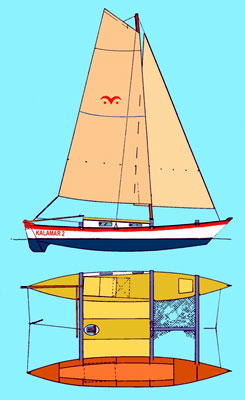
I decided to go back to a simpler kind of sailing for 2006 after loosing Intensity, my Grampian 26 monohull cruiser to Hurricane Katrina in 2005. I've long been fascinated with James Wharram catamarans and built one of his smallest designs the Hitia 17 beachcruiser, back in 1997-98. (See a photo and description here) I had originally planned to build one of his Tiki 26 or Tiki 30 cruising catamarans, but instead bought the Grampian 26 and put most of my time and energy for a few years into refitting and cruising on it. The disadvantages of a deep-draft keel boat have long been apparent to me, and the lack of truly safe harbors on the Mississippi coast when a hurricane threatens is definitely one of those disadvantages.
Most multihulls are shallow draft, and Wharram catamarans are designed to really take advantage of this feature, with hull forms that require no underwater appendages such as centerboards or daggerboards to enable them to sail to weather. They can dry out on a falling tide and even the bigger ones can be sailed right up to the beach. Although I have the building plans for the Tiki 26 and have long thought this was one of the most practical sizes for my needs, shortly after Katrina wrecked the Gulf coast I purchased a used Tiki 21 from a couple in Ocean Springs. The price was right and the catamaran came with a galvanized trailer. Trailerability was especially important to me with most of the marinas on the coast wiped out. I could bring the boat inland for a complete refit and take it back to the coast after some of the clean-up and rebuilding was done.
The Tiki 21 is an excellent beachcruiser style of boat. While too small to live aboard in the conventional manner, it does have a dry sea berth in each hull to make longer passages possible, and the expansive bridgedeck between the hulls makes a great platform to pitch a tent once the boat is anchored for the night. Although small, the Tiki 21 is a proven offshore passagemaker. It was designed as a coastal cruiser by James Wharram in the early 1980s and was never intended for long ocean passages. Despite this, a young man named Rory McDougall built one in Devon, England and left in 1991 bound for New Zealand. He eventually sailed on around the world, making the Tiki 21 the smallest catamaran in history to circumnavigate. He returned from the voyage enthusiastic about the boat, and continued to use it for shorter trips, with no desire to acquire a larger one.
It takes a different sort of mentality to voyage that far on such a small, mostly open boat, but Rory's completion of the trip shows what is possible. As he said, his boat would be considered luxurious by the standards of the ancient Polynesian voyagers whose craft were Wharram's design inspiration. Having traveled far in much smaller boats (namely canoes and sea kayaks), I'm familiar with the concept of simplicity and the advantages of carrying less and using less in the way of complex systems. The Hitia 17 that I built years ago was at the time my idea of a perfect small cruiser, but it's primary limitation was that there was no secure place anywhere on board to sleep while underway or to get out of the weather if caught out in bad conditions. It's also a bit limited in load carrying capacity for longer trips, where as the Tiki 21, with a capacity of 1,000 pounds, should have a good range for singlehanding, with room for everything one needs for this elemental form of cruising.
It seems to me that this boat, with its shallow draft of just 14 inches, stability and seaworthieness of it's deeply flared V-hulls with an overall beam of 12' and it's cruising speed of up to 10-12 knots in the right conditions, will be ideal for exploring the islands and estuaries of the Gulf coast. I can also envision cruising it among the far-flung mangrove cays of the Florida Keys and the Everglades, having a comfortable camping platform for overnight stops away from the mosquitoes and no-see-ums of the beach. A voyage across the Gulf Stream to cruise the Bahamas is certainly within its capacity for one willing to put up with a little discomfort, and such a trip is one of my goals for this boat. Wharram catamarans are being built and sailed throughout the world, and many resources are avaiblable on the Internet for those interested in these boats. The best place to start is at the source itself: www.wharram.com for information on all the designs available. As I complete the refit and modifications of my Tiki 21, I plan to post photos and commentary here for all who are interested.
Subscribe to:
Posts (Atom)


